
Spare Parts Selection & Sourcing
Genuine vs. Aftermarket Komatsu Parts: 7 Checks Before You Buy
Compare fitment, specifications, documentation, warranty terms, and total cost before choosing replacement parts.
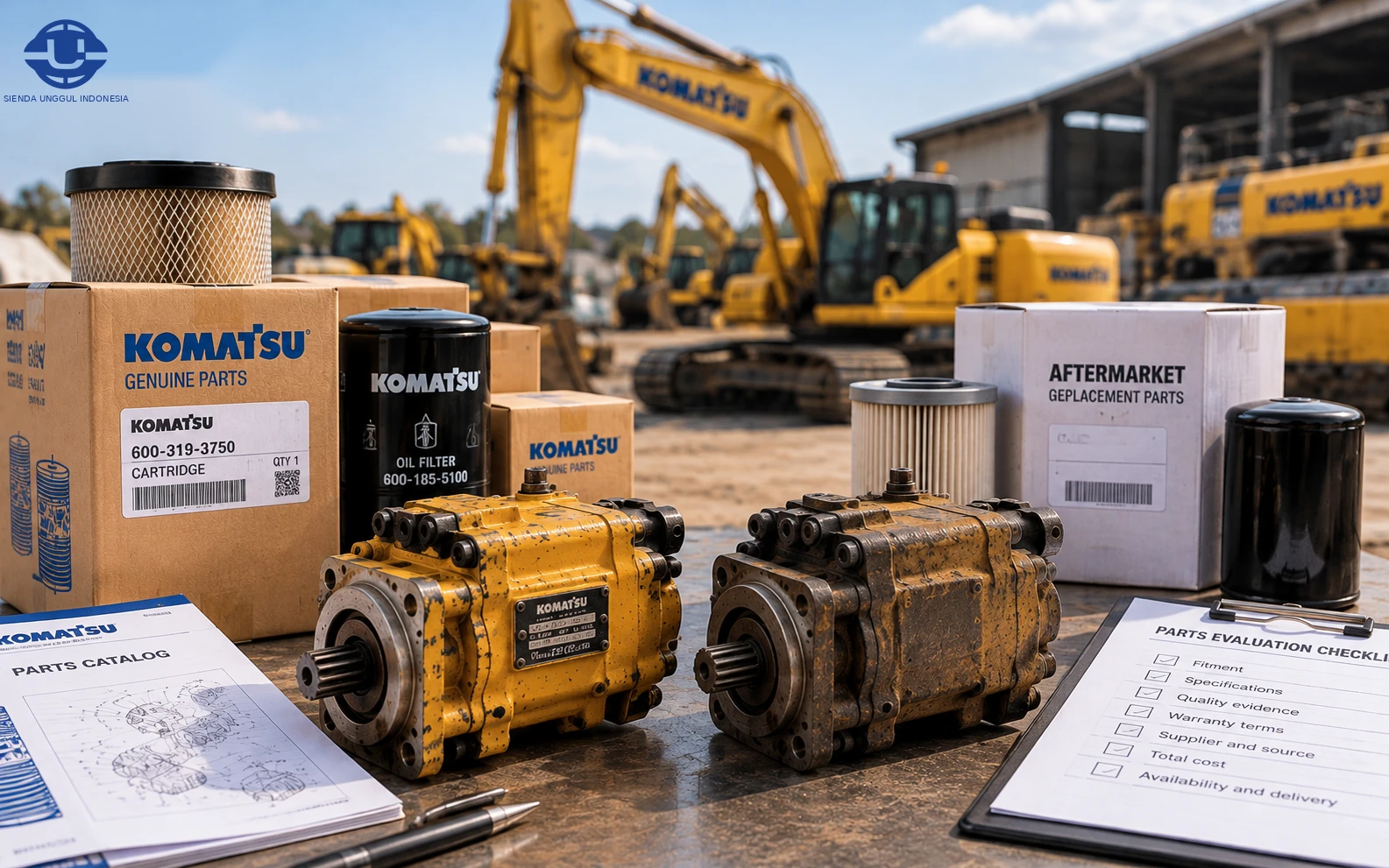
Choosing Komatsu replacement parts involves more than comparing prices. Use seven checks to evaluate fitment, specifications, quality evidence, warranty terms, traceability, and total cost.
Genuine vs. aftermarket Komatsu parts: what is the difference?
The choice between genuine and aftermarket Komatsu parts should be based on verified fitment, technical requirements, product documentation, applicable warranty terms, traceability, operational risk, and total cost—not purchase price alone.
Genuine parts are supplied through the equipment manufacturer's genuine-parts offering. Aftermarket parts are replacement components supplied by independent manufacturers or brands outside that genuine-parts channel. The aftermarket category includes different products and suppliers, so quality, specifications, traceability, and warranty support must be evaluated for the specific item.
Other options, such as remanufactured and used components, are distinct categories and should be evaluated separately.
The practical question is not simply which label is better. It is whether the specific component can be identified, shown to suit the machine and application, and supported with evidence appropriate to the risk of the job.
Understand the four parts categories first
| Category | What it means | What to verify |
|---|---|---|
| Genuine parts | Parts supplied under the equipment manufacturer's genuine-parts offering | Exact product identity, machine applicability, and applicable terms |
| Aftermarket parts | Replacement products supplied outside the genuine-parts channel | Manufacturer or brand, specifications, fitment evidence, traceability, and warranty |
| Remanufactured parts | Components processed through a remanufacturing program or process | Remanufacturer, process standard, inspection evidence, condition, and warranty |
| Used parts | Previously operated components | History, condition, remaining suitability, identification, and available support |
These categories are not interchangeable. In particular, a remanufactured component should not automatically be described as aftermarket, and a used component should not be evaluated as though it were new.
1. Genuine parts
Komatsu states that its Genuine Parts are manufactured according to the Komatsu Engineering Standards (KES), either in-house or under licence by selected suppliers. The manufacturer also describes specific product and maintenance offerings within its parts range.
Source: Komatsu — Genuine Parts
That statement describes Komatsu's own genuine-parts offering. For an actual quotation, confirm the identity of the specific product, its applicability, and the terms that apply in the relevant market.
2. Aftermarket parts
Aftermarket parts are replacement components supplied outside the manufacturer's genuine-parts channel. They are not a single technical specification or quality grade.
The important question is what can be established about the actual item being offered. A candidate part should be evaluated using evidence such as its product code, manufacturer or brand, relevant specifications, fitment information, available testing or inspection documentation, and written warranty terms.
Do not assume that every aftermarket component has the same level of documentation or support. Likewise, do not treat a product photograph or a general claim about a supplier as proof that a particular component is suitable.
3. Remanufactured parts
Remanufacturing is a process or product category distinct from simply supplying an aftermarket replacement. Its requirements, processes, and warranty should be checked for the actual program and component.
Komatsu's regional Genuine Parts information describes Komatsu Reman components as being returned to original specifications using its remanufacturing processes. The same page states that certain remanufactured components can be up to 40% less expensive than new components.
Important context: that percentage is a manufacturer-published claim about the specific regional offering on that page. It is not a universal price difference, an estimate of savings from aftermarket parts, or a guarantee of local availability in Indonesia.
Source: Komatsu — Genuine Parts and remanufactured components
When considering remanufactured parts, confirm the exact program, component eligibility, process information, warranty, availability, and any applicable core-return or exchange requirements.
4. Used parts
Used parts are previously operated components. Their suitability depends on factors such as condition, service history, inspection evidence, remaining service life, and compatibility.
A used component may have a lower purchase price, but the available evidence and the consequences of a failure matter. Ask for the item's identity, known history, relevant inspection results, and any terms covering its sale.
Evaluate used parts separately from new genuine, new aftermarket, and remanufactured components.
Seven checks before buying replacement parts
Check 1: Verify exact fitment
Confirm that the candidate part applies to the machine model, serial number, and relevant configuration.
Use an applicable parts catalogue, manual, or reliable parts-identification process. If the machine has been upgraded, rebuilt, or modified, disclose that history because the current configuration may affect the replacement requirement.
Do not use a similar-looking component as proof of fitment. If the supplier cannot confirm applicability using the information available, record that as unresolved.
For a step-by-step identification process, read How to Find the Correct Komatsu Spare Parts for Your Machine.
Check 2: Compare the required specifications
Identify the technical requirements that matter to the specific component and application. Depending on the part, these may include dimensions, connection details, material or performance requirements, filtration specifications, electrical characteristics, pressure ratings, or other application-specific criteria.
Not every item in this list applies to every component. Select the requirements relevant to the actual part, then request evidence that can be checked against those requirements.
Compare documentation for the exact products being quoted. General claims about an entire category cannot establish that a particular part meets the required specification.
Check 3: Evaluate quality evidence and traceability
Ask what evidence is available to establish the product's identity and the controls used to produce or inspect it.
Useful supporting information may include:
- Manufacturer or brand and product code.
- Relevant technical specifications.
- Inspection or test records, where applicable.
- Batch, lot, or other product identification, where available.
- Installation guidance or technical documentation, when relevant.
- Written information on intended application and limitations.
The level of documentation required depends on the component's risk and intended application. A component whose failure could have major operational consequences may justify a more demanding review than a routine consumable.
A photograph of the product is useful for identification, but it does not by itself establish internal specifications, quality controls, or compatibility.
Check 4: Read the applicable warranty terms
Warranty coverage can depend on the supplier, product, application, installation conditions, local law, and any separate equipment warranty.
Do not assume that the word "genuine" answers every warranty question, or that every aftermarket part automatically voids a machine warranty. Read the specific terms and request clarification when the decision could affect coverage.
Komatsu Australia's 2025 article on OEM servicing warns that aftermarket alternatives can introduce risks, including compatibility issues and potential warranty implications, within its service context. It is a manufacturer's statement—not a substitute for checking the contract and warranty that actually apply to your machine, product, and market.
Source: Komatsu Australia — The value of servicing with the OEM
Before committing, clarify:
- What warranty applies to the specific component?
- Who handles a claim?
- What evidence is required if a claim arises?
- Are installation or application conditions specified?
- Could the choice affect a separate equipment warranty or service agreement?
Check 5: Identify the supplier and product source
The product label alone may not establish who made, supplied, or supports the component.
Ask which manufacturer or brand is being quoted and what documentation accompanies the offer. Confirm that the quotation, product label, and supporting documents refer to the same item.
When two quotations use different descriptions for what appears to be the same component, clarify the exact product rather than comparing broad descriptions. This avoids treating unlike products as equivalent based on the wording of their listings.
Check 6: Compare total cost, not just purchase price
The lower-priced part is not automatically the lower-cost choice. A higher-priced part is also not automatically better value for every application.
The appropriate comparison includes the costs and risks relevant to the actual operating situation.
| Cost or risk factor | What to establish |
|---|---|
| Purchase price | Quoted price for the specifically identified component |
| Freight and handling | Delivery location, shipping cost, and any additional charges |
| Installation | Labour and installation requirements relevant to the part |
| Maintenance | Expected maintenance needs, based on reliable information where available |
| Replacement frequency | Evidence-based expectation, not an unsupported generic estimate |
| Downtime exposure | Practical operational consequences if the component fails or arrives late |
| Warranty and support | Applicable written terms and the process for obtaining support |
A useful planning formula is:
Estimated total cost = purchase price + logistics + installation + expected maintenance + estimated downtime impact − applicable recoveries or credits.
This is a decision framework, not a formula that can predict every outcome precisely. Use actual company figures when available and label assumptions clearly.
For example, the financial impact of one day of downtime will differ between an operation that has a substitute machine and one in which the affected machine is essential to a critical task. The comparison should reflect the actual operating context rather than a generic percentage or unsupported saving claim.
Check 7: Confirm availability, delivery, and support
A suitable part must also arrive when it is needed. Confirm whether the quoted item is available, whether the delivery date is confirmed or estimated, and what happens if the item is delayed or found to be unsuitable.
If a machine is already down, communicate the urgency and any constraints. A proposed alternative still needs its application and specifications checked; urgency does not remove the need for verification.
Keep the quotation tied to a clearly identified product so that the order, delivery, and any subsequent question can be traced to the same requirement.
A practical comparison matrix
Use this matrix to compare candidate parts or quotations on a consistent basis.
| Evaluation factor | Questions to ask | Evidence to record |
|---|---|---|
| Fitment | Is the part applicable to the actual machine? | Model, serial number, and relevant reference |
| Specification | Are the required characteristics supported? | Product documentation for the quoted item |
| Quality evidence | What can be verified about the product? | Available inspection, test, or traceability information |
| Warranty | Which terms actually apply? | Written warranty and exclusions |
| Traceability | Can the exact product and supplier be identified? | Product code, brand, source, and supporting records |
| Total cost | What costs and risks matter to this operation? | Purchase, logistics, labour, maintenance, and downtime assumptions |
| Supply and support | Is the delivery plan realistic, and who handles issues? | Availability confirmation and support arrangements |
Do not assign an automatic pass when information is missing. Mark it as "not confirmed" and decide whether the gap needs to be resolved before purchase.
A simple total-cost worksheet
Before comparing two options, fill in the available information.
| Input | Option A | Option B |
|---|---|---|
| Exact product and source | To be confirmed | To be confirmed |
| Fitment verification | To be confirmed | To be confirmed |
| Purchase price | Enter quotation | Enter quotation |
| Freight and other charges | Enter known costs | Enter known costs |
| Installation cost | Enter estimate | Enter estimate |
| Maintenance or replacement assumptions | State the evidence | State the evidence |
| Downtime assumption, if relevant | State the basis | State the basis |
| Warranty and support terms | Record written terms | Record written terms |
| Outstanding questions | List unresolved items | List unresolved items |
Do not compare the final totals until the underlying assumptions are reasonably comparable. If the fitment or a critical specification is unresolved, address that issue before treating the options as interchangeable.
What should you send when requesting a quotation?
A more useful parts enquiry includes the information needed to identify the machine, component, and delivery requirement.
- Full machine model and serial number, where available.
- Existing part number, if available.
- Component name and location.
- Required quantity.
- Clear component photos and any readable labels.
- Known machine modifications or relevant repair history.
- Delivery location and required timing.
- Any special documentation or warranty requirements.
These details help establish what needs to be checked before a product is selected. Exact availability, compatibility, and commercial terms still need confirmation for the specific requirement.
Frequently asked questions
Are aftermarket Komatsu parts always lower in quality?
No universal conclusion can be made about every aftermarket product. Suppliers, manufacturing processes, specifications, documentation, and support vary. Evaluate the particular part and the evidence available for it.
Are genuine Komatsu parts always the cheapest option?
Not necessarily. The price depends on the part and the offer. The meaningful comparison is between products that are suitable for the same requirement, taking applicable warranty, logistics, expected maintenance, and operational risk into account.
Is a remanufactured component the same as an aftermarket part?
No. Remanufactured describes a process or product category; aftermarket describes the supply category outside the manufacturer's genuine-parts channel. Confirm how the actual component is processed, specified, supported, and warranted.
Can I choose a replacement part using only a part number?
A part number is useful, but applicability may still need to be checked against the machine model, serial number, and component application. Provide the machine information whenever possible, particularly if the component or configuration is uncertain.
Does using an aftermarket part automatically void a machine warranty?
Do not assume that it automatically does or does not. Review the applicable equipment warranty, product terms, service agreement, local rules, and any installation or servicing requirements. Ask the relevant warranty provider for a clear answer if the decision could affect coverage.
What should I compare if the two quotations have different prices?
First confirm that both quotations identify suitable products for the same application. Then compare specifications, documentation, warranty, traceability, supply timing, logistics, and relevant operating costs. A price comparison is meaningful only when the underlying products and requirements are sufficiently comparable.
Discuss your spare parts requirement with Sienda
If you are evaluating replacement components for heavy equipment, start with the machine and part information, then discuss any unanswered fitment or sourcing questions.
Explore the Sienda Products page to understand the current product scope, or contact Sienda with the equipment details and parts requirement.
For the identification steps that should come before comparing quotations, read How to Find the Correct Komatsu Spare Parts for Your Machine.
Sources and further reading
- Komatsu — Genuine Parts
- Komatsu Australia — The value of servicing with the OEM
- Komatsu — Quick Reference Parts Guides
- Komatsu — Parts
This article is a general evaluation guide, not a claim that one parts category is suitable for every machine or operating condition. Verify requirements, product identity, compatibility, availability, documentation, and warranty terms before purchase.