
Komatsu Parts & Equipment
How to Find the Correct Komatsu Spare Parts for Your Machine
A practical identification guide using machine details, serial numbers, part numbers, and component information.
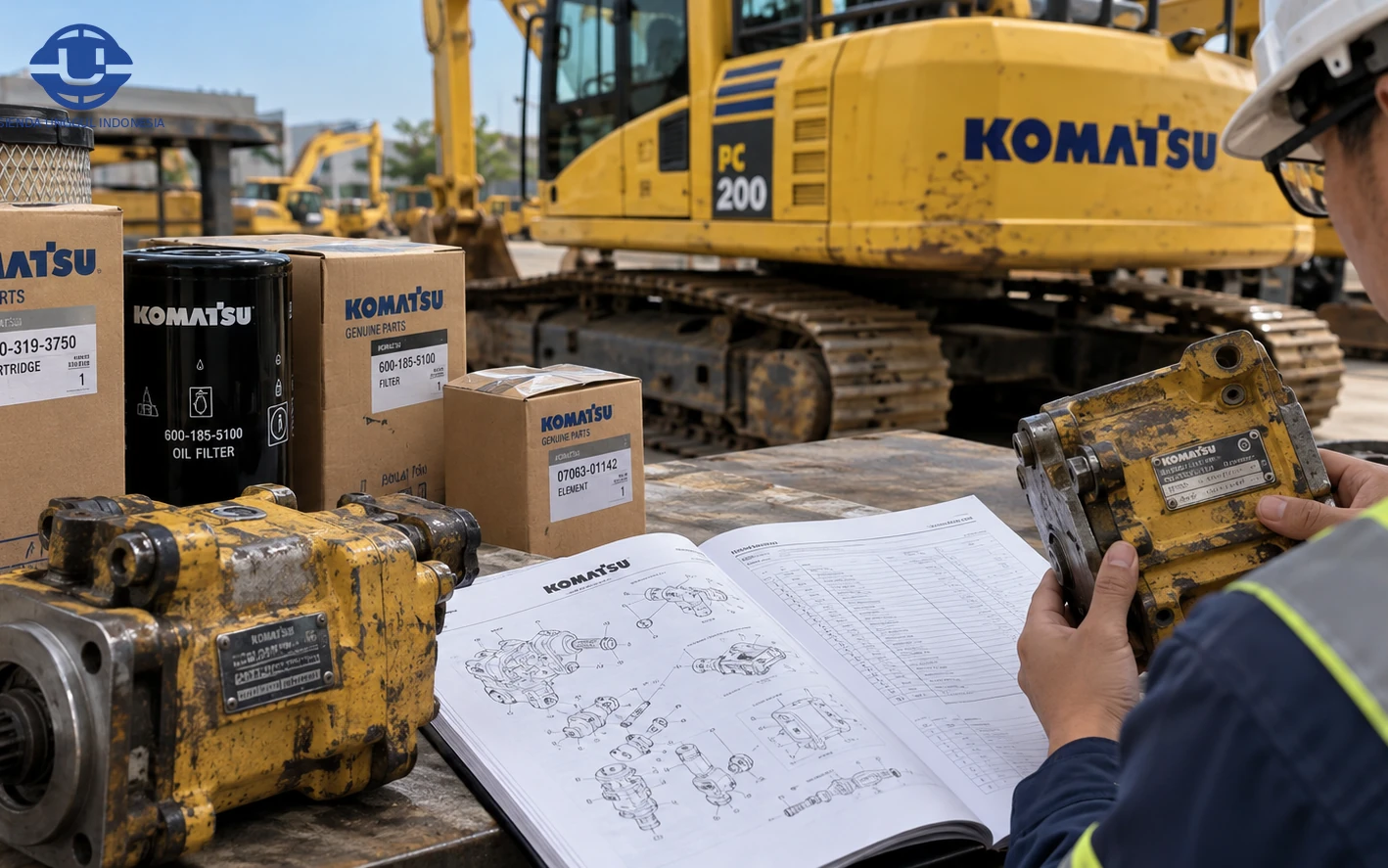
Learn how to identify Komatsu spare parts using your machine model, serial number, part number, and component details before ordering or requesting a quotation.
How do you identify the correct Komatsu spare part?
To identify the correct Komatsu spare part, start with the machine model, machine serial number, existing part number (if available), component location, and clear photos of the part. Then cross-check the details against an applicable parts catalogue, equipment manual, or reliable parts-identification process before ordering.
The key principle: a machine model or a similar-looking component is not always enough to confirm fitment. Two parts can look alike while differing in specifications, application, or applicability to a particular machine configuration.
A good spare parts enquiry contains enough information to identify the equipment, narrow down the component, and verify the candidate part before a purchase decision is made.
The five details to prepare before ordering
| Information | Why it matters | What to provide |
|---|---|---|
| Machine model | Narrows the equipment family and relevant references | Full model designation from the machine or documentation |
| Machine serial number | Helps check configuration or serial-range applicability when supported by the reference | Record or photograph the identification plate |
| Existing part number | Provides a candidate identifier for cross-checking | Number from the part, label, packaging, invoice, or prior quotation |
| Component location | Identifies the system or assembly in which the part is used | For example, engine, hydraulic system, transmission, or filtration |
| Photos and quantity | Adds visual context and clarifies order requirements | Clear component photos, readable markings, and required quantity |
Not every enquiry will include all five details. However, providing as many as possible generally gives the person identifying the component more context and can reduce avoidable clarification.
Step 1: Confirm the exact machine model
Begin with the full model designation rather than a broad description such as “Komatsu excavator” or “Komatsu dozer.”
The model helps narrow the relevant equipment family and parts information. It is a starting point, not always a sufficient fitment confirmation by itself.
Use the machine identification plate and equipment documentation as references. Record the designation exactly as shown. Avoid replacing it with an informal nickname or an approximate model description.
If the machine has been rebuilt, upgraded, or modified, mention that history when it could affect the component being requested.
Step 2: Record the machine serial number
The serial number can be an important identification input because parts applicability may depend on the machine configuration or production range.
Komatsu has described this principle in its own parts-support information. In a July 2022 announcement about scheduled-service parts in New Zealand, Komatsu explained that myKomatsu could prepare a service-parts list matched by serial number to the customer's actual machine. The announcement also described searching for scheduled-service parts by machine model or serial number.
That announcement describes a particular regional service and workflow. Access, functionality, and availability can differ by market and equipment family. It nevertheless illustrates why serial-number information is worth preparing instead of relying on the model name alone.
Source: Komatsu — myKomatsu scheduled-service parts
Record the serial number carefully. If a character is unclear, photograph the identification plate rather than guessing.
Step 3: Find the existing part number, if available
If the old part is still available, inspect it and its packaging for part numbers, labels, and other identification marks. Previous maintenance records, invoices, and quotations may also contain useful references.
An existing number is useful evidence, but it still needs to be checked. It may have been copied incorrectly, identify a related assembly, or refer to a part whose applicability requires confirmation.
When there is uncertainty, provide the number alongside the machine model and serial number. Do not treat a number from an unrelated online listing as final confirmation.
Komatsu publishes Quick Reference Parts Guides for selected equipment models. The guides organize information such as part numbers, quantities, and relevant specifications. Their listed equipment families include dozers, excavators, motor graders, haul trucks, and wheel loaders.
The guides and available models depend on the catalogue and region. Check that the reference applies to the machine and application in question.
Step 4: Identify the assembly and component position
Some parts belong to a larger assembly. A request for a pump, seal, bearing, filter, or other component may require clarification about exactly which assembly or position is involved.
Describe where the part is installed and what it connects to. If an applicable parts diagram or manual is available, include the relevant reference or a screenshot with the part position clearly indicated.
For example, “hydraulic part” provides limited context. A description identifying the relevant assembly, component location, and readable part number gives the enquiry a stronger starting point.
Do not assume that two components are interchangeable just because their shape or dimensions appear similar. The required specification and machine applicability still need to be established.
Step 5: Use photos to support identification
Photos are useful supporting evidence, especially when a label or part number is difficult to read.
For a useful identification set, include:
- A clear photo showing the entire component.
- A close-up of the number, label, or marking.
- A view of relevant connection points or mounting features, where practical.
- A photo of the packaging label or previous record, if available.
Photos support the identification process; they do not replace catalogue or specification checks. A photo alone may not establish internal dimensions, material specifications, or whether a component applies to a particular machine serial range.
Step 6: Cross-check before ordering
Once a candidate part has been identified, verify that the available information is consistent.
| Check | Question to resolve | Useful evidence |
|---|---|---|
| Machine applicability | Does the reference apply to this model and configuration? | Applicable catalogue or equipment documentation |
| Part identity | Does the part number match the intended component? | Markings, product documentation, or a reliable parts reference |
| Specification | Are the relevant technical requirements satisfied? | Specifications or documentation for the exact part |
| Quantity | Is the required quantity known? | Parts list and actual maintenance requirement |
| Previous modifications | Could the machine history affect the choice? | Maintenance, repair, or rebuild records |
| Supply details | Is the proposed item clearly identified in the quotation? | Written quotation and product information |
If important information remains uncertain, identify the uncertainty before purchase. Do not treat a missing detail as confirmation that the part is suitable.
What can cause a spare part to be incompatible?
A part can appear to match a request while still being unsuitable. Common causes include:
- The equipment model or serial number was recorded incorrectly.
- The candidate part applies to a different configuration or serial range.
- The number identifies a related assembly rather than the individual component required.
- A previous repair or modification changed the equipment configuration.
- The part appears similar but has different technical specifications.
- The available listing does not provide enough evidence to confirm applicability.
The appropriate verification process depends on the component and the available documentation. Where the consequence of an incorrect part is significant, stronger technical confirmation may be appropriate.
What if I only have a photo of the part?
Start with the photo and provide any supporting details available. Include the machine model and serial number if you can find them, as well as the component's location and required quantity.
If the part number is unreadable or missing, explain that directly. It is better to mark an identifier as unknown than to supply a guessed number that could misdirect the enquiry.
What if I have a part number but no machine serial number?
Provide the part number alongside the full machine model and any previous records you have. Ask for the part's applicability to be checked before committing to an order.
A part number is a useful identifier, but the number alone may not establish that the candidate is correct for every configuration of a machine model.
Can I use an online catalogue to identify Komatsu spare parts?
Yes. Online catalogues and machine-specific parts guides can help narrow down the search. Komatsu's parts page describes its parts offering and access to parts resources.
Always check whether the reference, model, and configuration apply to the equipment in question. Catalogue access and functionality can differ by region. If the available information is incomplete, request clarification before ordering.
A practical pre-enquiry checklist
Before contacting a supplier, prepare what you can:
- Record the full machine model.
- Record the machine serial number or photograph its identification plate.
- Include the existing part number, if available.
- Describe the component and where it is installed.
- State the required quantity.
- Attach clear photos of the component and its markings.
- Mention known machine modifications or relevant repair history.
- Explain delivery timing or documentation requirements.
This checklist does not guarantee compatibility. It helps the enquiry start with useful information and makes it easier to identify what still needs verification.
Need help identifying a spare part?
You do not need to guess at a missing identifier. Share the machine and component information you have so the specific requirement can be understood and the next verification step determined.
Explore the Sienda Products page or contact Sienda with your equipment details and spare parts enquiry.
For the next step in evaluating a replacement, read our related guide: Genuine vs. Aftermarket Komatsu Parts: 7 Checks Before You Buy.
Sources and further reading
This guide provides general parts-identification support. Verify the correct part and its applicability against documentation and the actual equipment configuration before purchase.